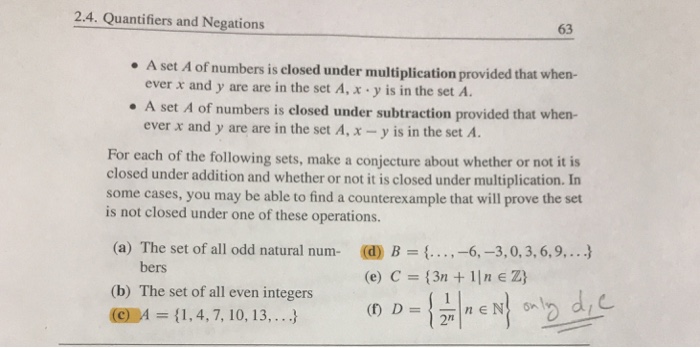
Which Set Of Numbers Is Closed Under Subtraction . The notion of closure is generalized by galois connection , and further by monads. Thus, we see that for addition, subtraction as well as multiplication, the result that we get is itself a rational number.
Solved , 4 Quantifiers And Negations 63 . A Set A Of Numbers | Chegg.com from www.chegg.com
Or in reverse if you can find a pair of numbers in the set where the operation results in a number not in the set then that set is. Which of the following sets are closed under subtraction?
Solved , 4 Quantifiers And Negations 63 . A Set A Of Numbers | Chegg.com
For example, the closure under subtraction of the set of natural numbers, viewed as a subset of the real numbers, is the set of integers. Operations under which a particular set is not closed require new sets of numbers: D) the set of natural numbers is not closed under the operation of subtraction because when you subtract one natural number from another, you don’t always get another natural number.
Source: studylib.net
Or in reverse if you can find a pair of numbers in the set where the operation results in a number not in the set then that set is. Actually, when you subtract odd numbers, you always get an even number! Which set is closed under subtraction?
Source: slidetodoc.com
Prime numbers are closed under subtraction. At some point, people were confronted with the problem of having to divide one thing among more than one person. If an element outside the set is produced, then the operation is not ___.
Source: www.youtube.com
Which of the following sets are closed under subtraction? The rational numbers are closed not only under addition, multiplication and subtraction, but also division (except for $$0$$). Two whole numbers the result is also a whole number, but if we try subtracting two such numbers it is possible to get a number that is not in the set.
Source: mathbitsnotebook.com
The set of real numbers is closed under subtraction because a, b ∈ r does imply a − b ∈ r. Actually, when you subtract odd numbers, you always get an even number! They are not closed under division because, for example, 1 , 0 ∈.
Source: www.chegg.com
This set is often in folders with. Whole numbers are not closed under subtraction. If you subtract 3 from11, the answer is 8, which is not an odd number.
Source: brainly.in
This set is often in folders with. Operations under which a particular set is not closed require new sets of numbers: This same set is not closed under subtraction since 1 −.
Source: slideplayer.com
This set is often in folders with. −5 is not a whole number (whole numbers can't be negative) so: A/b * c/d = (ac)/(bd), so closed under.
Source: slideplayer.com
Usually (not generally) it involves an operation, for example: A set is ___ (under an operation) if the operation always produces an element of the same set. An important example is that of topological closure.
Source: study.com
Operations under which a particular set is not closed require new sets of numbers: Negative integers, integers and rational numbers are the sets of numbers among the choices given in the question that are closed under subtraction. Irrational numbers $$\mathbb{i}$$ we have seen that any rational number can be expressed as an integer, decimal or exact decimal number.
Source: brainly.com
−5 is not a whole number (whole numbers can't be negative) so: If we enlarge our set to be the integers This means that rational numbers are.
Source: www.meritnation.com
An important example is that of topological closure. System of whole numbers is not closed under subtraction, this means that the difference of any two whole numbers is not always a whole number. Whole numbers are not closed under subtraction.
Source: www.youtube.com
Thus, we see that for addition, subtraction as well as multiplication, the result that we get is itself a rational number. This is known as closure property for subtraction of whole numbers. Which of the following sets are closed under subtraction?
Source: www.chegg.com
D) the set of natural numbers is not closed under the operation of subtraction because when you subtract one natural number from another, you don’t always get another natural number. For example, the closure under subtraction of the set of natural numbers, viewed as a subset of the real numbers, is the set of integers. Which set is closed under.
Source: www.youtube.com
Actually, when you subtract odd numbers, you always get an even number! Usually (not generally) it involves an operation, for example: D) the set of natural numbers is not closed under the operation of subtraction because when you subtract one natural number from another, you don’t always get another natural number.
Source: brainly.in
Or in reverse if you can find a pair of numbers in the set where the operation results in a number not in the set then that set is. At some point, people were confronted with the problem of having to divide one thing among more than one person. Natural numbers are closed under division.
Source: www.chegg.com
Which of the following sets are closed under subtraction? If you subtract two whole numbers, you do not always get a whole number. Prime numbers are closed under subtraction.
Source: www.youtube.com
Or in reverse if you can find a pair of numbers in the set where the operation results in a number not in the set then that set is. Irrational numbers $$\mathbb{i}$$ we have seen that any rational number can be expressed as an integer, decimal or exact decimal number. This is a general idea, and.
Source: mathbitsnotebook.com
One can define the difference between $a$ and $b$, $a, b \in \mathbb n\,$ in terms of the magnitude of the difference: Which of the following sets are closed under subtraction? For example, the closure under subtraction of the set of natural numbers, viewed as a subset of the real numbers, is the set of integers.
Source: slideplayer.com
The set of real numbers is closed under subtraction because a, b ∈ r does imply a − b ∈ r. Whole numbers are not closed under subtraction. Negative integers, integers and rational numbers are the sets of numbers among the choices given in the question that are closed under subtraction.
Source: slideplayer.com
Usually (not generally) it involves an operation, for example: Two whole numbers the result is also a whole number, but if we try subtracting two such numbers it is possible to get a number that is not in the set. Negative integers, integers and rational numbers are the sets of numbers among the choices given in the question that are.